Category Archives: The Lucky Mom

For all of it, I am thankful.

It was 1999, and I was standing in the checkout line at the grocery store with my cart full of groceries, when I picked up a Family Circle magazine. I flipped through, browsed a couple of recipes and some Thanksgiving decor. Then my fingers turned to the back of the magazine, where I read words that changed my life.

I always thought of myself as a positive person, and it was easy to be thankful for the positive things. My family, my job, the vacations we enjoyed, the new house we had just moved into. What I hadn’t yet grasped was the concept of total gratitude.

Gratitude for the whole package of life.

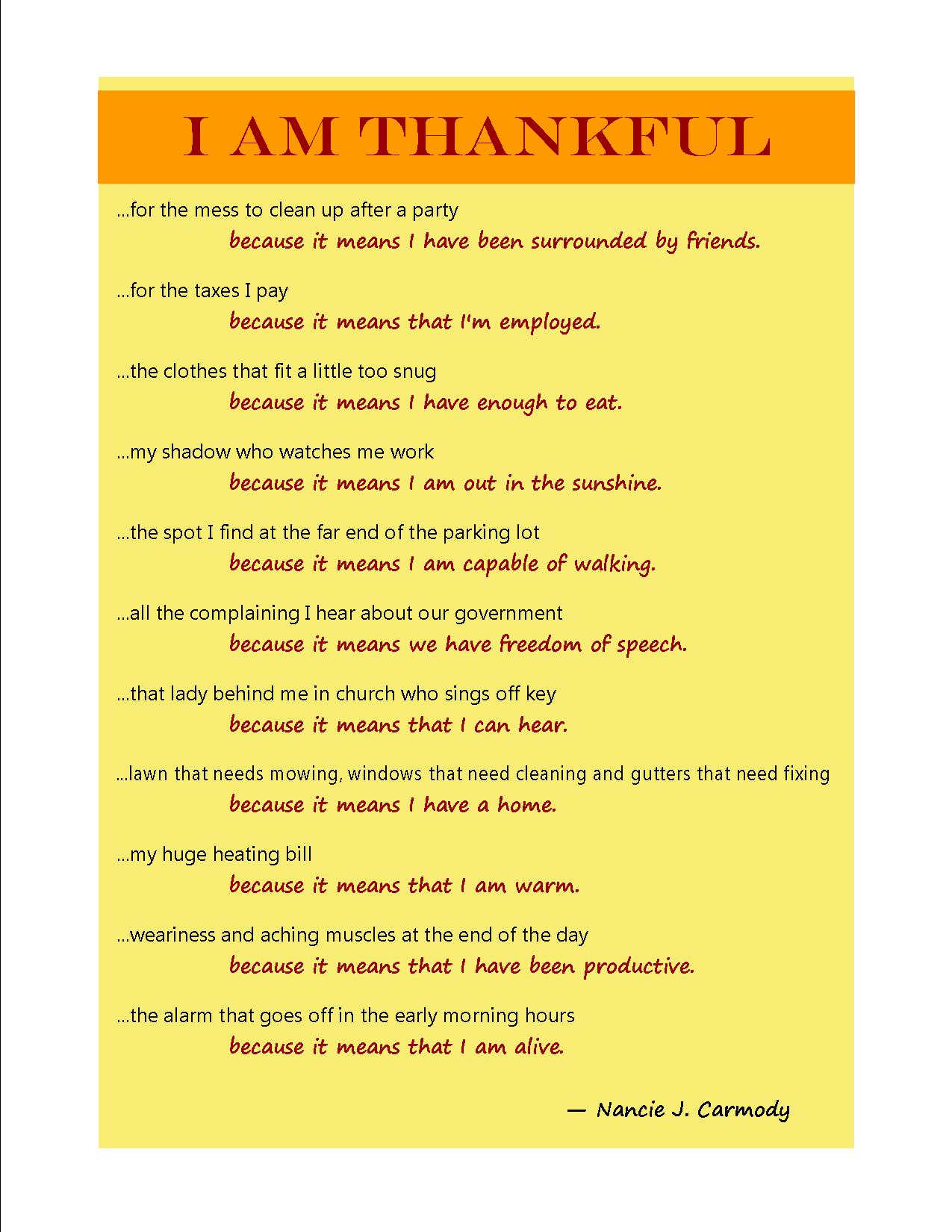
And I read these words that rocked my world. They stayed on my refrigerator for a couple of years. (In fact, they stayed there til 2005, when a certain hurricane left things a little damp inside my home.)

So I sought it out on the internet, and typed it up to put back on my fridge. And I’m posting it here, in case you want to print it out for your fridge, too.


I hope these words come to mean as much to you as they have to me.

Happy Thanksgiving. I am thankful for you.

A Big Win for a Little Boy

Last night I had the great pleasure of judging a speech competition at a local elementary school.

To fully understand this, I need to tell you a little about the public schools in my community. They’re not great. (Apologies to those who disagree.) I live in Louisiana, where our schools consistently hover between 48th and 50th in performance nationally. (We get excited when Mississippi sucks worse than we do.)

And I’m sure I’ll catch some flack for saying this, but I’m going to say it. Except for the bright kids in the magnet schools – most of the kids in our public schools are those whose parents can’t afford private tuition and those who require services that private schools don’t offer. We’re talking the lower end of the socio-economic spectrum and the Special Ed kids. It is what it is.

In the years I’ve worked with speech competitions, I’ve coached kids for whom English isn’t their first language (sometimes it’s not even spoken in their homes). Hearing-impaired and autistic students. Children whose parents couldn’t afford to buy a costume prop so their child could look a little like Abraham Lincoln when delivering an excerpt from the Gettysburg Address.

But they practice and work hard, and a lucky few score high enough in their classroom competitions to make it to Speech Night.

So last night, when Rick (not his real name) stepped up on the stage, I took a breath. He embodied every stereotype of a bullied kid – heavy-set, pale-skinned, lumbering on the stage awkwardly. While the other boys had costumes or trendy attire, he had his collared shirt neatly tucked in, and was wearing a belt. Fifth grade boys don’t tuck their shirts in and wear belts when they have a choice. He looked out of place. He looked different.

He approached the microphone and introduced himself and his speech. He would be delivering a passage from Ronald Reagan’s “Tear Down That Wall” speech in Berlin. Big shoes for an awkward kid.

The Gipper would have been proud.
Photo via Wikipedia.

He paused after his introduction, and words started pouring out of his mouth with an eloquence I cannot describe. His clumsiness disappeared, and chills ran through my body.

All of the awkwardness was gone, replaced with confidence and conviction.

He delivered the speech, and applause filled the room. And I realized that moment just might be a defining moment in this boy’s life.

The other contestants delivered their speeches, and the scores were being tallied while the nervous students waited. It was the moment of dread, where a handful of students were to be declared winners, and others would go home trophy-less and disappointed.

Rick was the winner. First place. He seemed a little stunned, and not quite sure how to handle himself with all the applause and praise.

You see, Rick is autistic. The playing field for him runs uphill. But last night, on the big stage in his school, he was The Best. Better than the athletic boys, better than the well-spoken girls.

As I looked over at the chairs where the kids who didn’t win were sitting, I saw a boy with his face in his hands, crying in front of his classmates and teachers. His speech had been from his idol, a professional athlete from our home town. And he really thought he was going to win.

Then I saw Rick. Beaming.

That other boy will have lots of trophies before he grows up, but this might be one of the only big wins for Rick. This trophy that he earned in fifth grade might be the motivation he needs to try harder, to overcome more. This trophy will mean the world to him.

Because a little validation goes a long way, even for kids. And last night, the judges, his teachers, and the world (at least the world as he knows it) said he was The Best.

I hope today he greets his classmates with a new-found confidence. I hope today he takes on his schoolwork with a little more energy. I hope the smile that he left the auditorium with last night doesn’t leave his face for a long, long time.

I hope he remembers what it feels like to be The Best.

Lessons From Paris: Le Flâneur

For one glorious week, I walked the streets of Paris.

I wandered, I ambled, I strolled.

I took in the sights and sounds.

I smelled, I tasted.

I experienced.

Just the way I always dreamed I would.

When my cousin S extended a very generous invitation – to accompany him on a cultural expedition of the City of Lights, I actually hesitated before saying “Yes.” (You can read all about that here.) But say “Yes” I did, and a couple of weeks ago I actually did it. I got on a plane, left my husband and kids behind, and went to Paris. All in.

Our travel party grew to three when S’s friend D joined us in the Atlanta airport. From there, we flew through the night, each anticipating our arrival from different sections of the plane. Sleep was elusive, and the on-board French wine did little to calm my excitement. I was on my way to Paris!

Upon arrival, our mission became clear. To immerse ourselves as much as possible. Not to ‘see’ Paris through the lens of a camera or the pages of a guide book an iPhone app. Not to ask for the English menu, and find something we might like. Not to seek out the pop-culture images we’d learned from our side of the pond. (Well, maybe a few.) But to BE in Paris. To EXPERIENCE Paris. To LIVE in Paris for one week.

The first day, I found something to marvel at with every step. A peek down an angled street, the pattern in the cobblestones, the wrought-iron balcony rails – all took my breath away. I resisted the urge to take photos of everything, instead wanting to just be part of it.  There was plenty of time.

Over the following days, the lessons came. Lessons about art and history and architecture. But mostly about life. About my life. And maybe yours, too.

And I want to share some of them with you.

————————————-

Lessons from Paris. Part One: Le Flâneur

Neither Dictionary.com nor Merriam-Webster.com has a definition for this word. Perhaps it doesn’t translate well into English because it’s not a concept we can really grasp here. WordReference.com does a decent job at attempting to translate it here.

Paul Gavarni, Le Flâneur, 1842.

But the essence of this word can’t be captured in a two-dimensional way. One must do it to understand. One must become a flâneur.

Variations of the verb flâner date back to the 16th and 17th centuries, when it referred to walking about with the intent of wasting time. It was in the 19th century when the word developed the rich meaning and connotation it holds today – that of an intellectual urban explorer, a connoisseur of the street, one whose purpose for strolling outdoors was to take in the culture surrounding him.

__________________________________________________

Tourist vs. flâneur.

A tourist is a person engaged in travel for recreation or leisure, often learning about their destination through the filter of a guide or book.

A flâneur wanders a place for the sake of experiencing that place, developing a relationship with his or her surroundings in the process. There is no specific destination. This concept of the flâneur was presented in the 1860s by the French essayist Charles Beaudelaire.

“The crowd is his element, as the air is that of birds and water of fishes. His passion and his profession are to become one flesh with the crowd. For the perfect flâneur, for the passionate spectator, it is an immense joy to set up house in the heart of the multitude, amid the ebb and flow of movement, in the midst of the fugitive and the infinite. To be away from home and yet to feel oneself everywhere at home; to see the world, to be at the centre of the world, and yet to remain hidden from the world – impartial natures which the tongue can but clumsily define. The spectator is a prince who everywhere rejoices in his incognito. The lover of life makes the whole world his family…”1

Paris taught me to be a flâneur. Not a tourist when I am away from home, not a participant in my own life when I am at home. But a connoisseur of life always.

“Be always drunken.

Nothing else matters:
that is the only question.
If you would not feel
the horrible burden of Time
weighing on your shoulders
and crushing you to the earth,
be drunken continually.

Drunken with what?
With wine, with poetry, or with virtue, as you will.
But be drunken.

And if sometimes,
on the stairs of a palace,
or on the green side of a ditch,
or in the dreary solitude of your own room,
you should awaken
and the drunkenness be half or wholly slipped away from you,
ask of the wind,
or of the wave,
or of the star,
or of the bird,
or of the clock,
of whatever flies,
or sighs,
or rocks,
or sings,
or speaks,
ask what hour it is;
and the wind,
wave,
star,
bird,
clock will answer you:
“It is the hour to be drunken!”

                                   ― Charles Baudelaire, Paris Spleen, 1869

__________________________________________________

1 Charles Baudelaire, “The Painter of Modern Life”, (New York: Da Capo Press, 1964). Orig. published in Le Figaro, in 1863.

Saying ‘oui’ to Paris. Saying ‘yes’ to myself.

Call Verizon to add international package. Check.

Call the bank to authorize shopping charges. Check.

Check with airline for flight changes. Check.

Confirm hotel reservation. Check.

Holy cow. I’m actually going to do this. The day after tomorrow I’m getting on a plane to Paris. Without my husband and kids.

Please, God, don’t let this be a dream.

I have never done anything this self-indulgent before. I rarely do anything self-indulgent. My idea of a big treat is lunch with a friend squeezed between errands and carpool. So when this email came back in May, I didn’t even know how to respond.

 “If I bought a ticket would you be interested in going to France for a week in mid-October? A translator would be nice.”
 

“What a lovely idea…” was my immediate thought. But I decided not to say ‘no’ right away. To live the fantasy in my head for a day or two before I squashed it.

I pictured myself sitting in a café with a cup of coffee glass of wine and my camera. I practiced a few lines of my long-forgotten French to see if I could even pull off ordering a glass of wine. I mean, it’s been over 30 years since my summer in Quebec, so offering my services as a translator would really be a joke. But it was a lovely thought.

Thank you, Microsoft, for this royalty-free image. Next week I’ll have my own photos to share!

I hung on to it for a few days. And then, in a moment of uncertainty, I mentioned it to my family at the dinner table. It took my husband a moment to speak. He said, “Have you said ‘Yes’ yet?” And without overthinking it, I said, “No, but I think I will.”

And the planning began.

A few months passed, and (even though my plane ticket was proudly displayed on the refrigerator) I refused to allow myself to get excited about it. There are so many wildcards in my life right now, and I feared something would crash down and force me to cancel if I blabbed all over the internet months in advance. So I waited cautiously. Realistically. Hopefully.

And the Universe cooperated, as if to tell me that I was worth all of this. And now, here I am, ready to take off to Paris with my cousin on a Bucket List sort of adventure. To drink in (pun intended) all that Paris has to offer. Art, history, architecture, food, wine, music… all by myself. (Well, by myself meaning without my husband and kids.)

About a month ago I started talking about it. Making it feel real. Shopping for something chic to wear.

For the last week I’ve been mumbling to myself en francais, picking up travel bottles for shampoo, and sporting a grin that just won’t go away.

Today I’m making a list for Mr. Wonderful of carpool schedules and cross-country meets and sending emails to make sure every detail is taken care of.

Tomorrow I’ll pack the suitcase.

And the next day, I’ll get on a plane and fly across an ocean and arrive in a place I’ve been waiting my whole life to be.

And I’ll take pictures and drink wine and visit cathedrals. And I’ll thank my cousin a bazillion times for asking that question back in April.

And I’ll come home a better person for having said ‘yes’ to myself.

Life is Good Enough.

Good enough.

I used to hate those words. They always seemed like a cop-out.

Then I had three kids. And we bought an apartment building. And got a dog. And I started taking care of my in-laws. And I just couldn’t keep up with my old standards any more. I started to feel inadequate, and beating myself up regularly over the things I couldn’t get done.

But I found a solution. A way out of the self-imposed guilt. I’ve turned over a new leaf.

I’ve embraced mediocrity.

And now, good enough has become . . . Good Enough. Not just a measure of acceptance, but a whole new philosophy for life. A new mantra.

Here are a few excerpts from the Good Enough Manual:

Good Enough Laundry = clean (for the most part). The kid who hasn’t yet gone through puberty may occasionally wear shirts more than once. Folding is optional. And you already know how I feel about sorting socks.

No more shame!

Good Enough Dinner = everyone eats something. Most nights I provide the meal. Most nights we eat together. But if we can’t, we can’t. My children are now old enough to handle sharp knives and prepare food. They know the way to Subway. They won’t go hungry.

Good Enough Housekeeping = a reasonable standard of hygiene in the bathrooms and kitchen. Enough said.

Dusting is now optional.

Good Enough Landscaping = the weeds will die once we have a cold snap. Probably. If not, they’ll bloom in the spring and I’ll call it a garden.

I’m no longer envious of my friends with their picture-perfect homes and spotless cars. They can hop in with me and we can go to lunch. Or we can drive out to the lake and eat Cheerios off the back seat. It doesn’t matter to me.

This weekend we’re going to a cross-country meet in Baton Rouge. Instead of rushing home as soon as The Caboose crosses the finish line, we’re going to go visit The Trailblazer at LSU. We’re going to enjoy a little October weather and I’m not going to worry about housework.

When I get home I may print up some membership cards to the Good Enough Club. Who wants one?


Boiling Frog Syndrome

I often use a metaphor to describe how we sometimes find ourselves in situations we didn’t see coming. It goes something like this:

If you put a frog in a pot of hot water it will jump out immediately, because it senses danger. But if you put a frog in a pot of cool water and heat it slowly, the frog will adapt to the changes. It will not perceive danger, and eventually it will cook to death.*

I fear I’ve become a victim of Boiling Frog Syndrome.

(Photo © 2010 J. Ronald Lee.)

I used to live a very organized, efficient life. I worked outside the home, worked inside the home, mothered three kids. As an Army wife, I often did it solo. I managed our rental properties, cared for my parents, volunteered at my kids’ schools, taught Catechism at my church. And all the while I managed to maintain a decent standard of hygiene in my home and a semi-active social life.

I’m not sure when the fire was turned on under me, but somewhere along the way that cool pot started heating up, and my surroundings became a threat to my survival.

At some point, having the right uniforms clean on school days became a challenge. (Enter Febreeze into my life.)

Homework became a lifestyle-altering component of my family’s schedule.

Carpool and lacrosse practice became the events that dictated the rest of the day.

I had to take an afternoon off of work to wait for the exterminator, the plumber, the AC guy.

Meals at home became grab and go events, not sit downs.

Taking my parents and in-laws to the doctor became a frequent activity.

I was overwhelmed by my routine day.

Lists didn’t help. I never could get the things on the list done by the time they were supposed to be done. The unchecked list became a reminder of my failure.

Requests for assistance didn’t help. I had created a system that only I knew, so asking for help meant doing it over when it wasn’t done right, and stopping to explain ‘what or how’ became as time-consuming as doing it myself. I had painted myself into a proverbial corner.

Years went by, and I couldn’t figure a way out. I reminded myself to be patient. “This, too, shall pass,” became my mantra. I watched as my friends went on weekend jaunts to Napa, while I tried to dig out of paperwork. I was jealous of those who went to the zoo when I could barely get to the grocery store. The lists grew longer and longer. But I couldn’t figure out how to change anything.

The events of the last year turned the fire up even hotter. And I started to feel the heat. Anxiety attacks, hives, a trip to the ER after passing out. My body was sending me clear signals, but I still couldn’t figure out how to reduce the flame beneath me. I knew I had to get out of the pot for my own survival, but I just couldn’t find the way out.

So I scoured the internet for some inspiration, and I stumbled on this blog.

The steps seemed simple enough, so I thought I’d give it a try to see how I could apply these business practices to my life.

7 Tips for Prioritizing Tasks Effectively

1. Respect Deadlines.

An absolute must. I was prone to putting off the things that stressed me the most, even if there was a cost. Practical translation: Laundry must be done. If I have to Febreeze a uniform so my son can wear it to school unwashed, I’ve failed. Monday morning, laundry must be caught up.

2. Set Milestone Deadlines.

Don’t complete one task at the expense of the others. If it all has to be done, set reasonable milestones and work toward them. Leaving a monumental task until the last minute will bite you in the ass every time. Practical translation: The insurance claim must be filed within two weeks. The apartment must be ready to show by the 20th.

3. Consider the Consequences.

There will be things that just can’t get done. Choose the ones you can let go, and then… let them go.  Practical translation: I won’t be making those spectacular Halloween decorations I saw on Pinterest. In fact, I’m may delete my Pinterest account. All it does is make me feel more inadequate.

4. Consider the Payment Terms.

Some commitments do pay rewards. Get them done. Practical translation: Get the apartment ready. Missing another month’s rent will set the cause back even further. Two teenage boys on the car insurance is no laughing matter.

5. Consider Time Required.

When facing two equally important tasks I’ve started using the low-hanging-fruit method. Practical translation: Choose the one I can get finished. The reward of checking something off that list will often give me the energy to tackle the next one. And then the next one.

6. Set Goals and Work Backwards.

Keep the big picture in mind. Prioritize the steps, keeping in mind that some are foundational for others. Doing things in the wrong order makes for extra work. Practical translation: Clean the kitchen before starting dinner. Put away laundry before packing for vacation.

7. Schedule a Percentage of Your Time for Personal Projects.

Personal indulgences were always the first thing to be cut. But tasks that energize me – even if they take up valuable time – leave me better equipped to tackle the necessary things. Cutting these activities backfired on me in the long run because it left me feeling unfulfilled. Practical translation: Don’t eliminate the things that fulfill me. Spend time with friends. Exercise. Read. Dare I even say it… travel.

Now I’m not sure if using this method is going to solve my problem. But I am already gaining some sense of control over things, and I’m sure that will cool the water down a bit. I’m giving myself a month to knock out some big items and make decisions on how to work smarter on the small items. And I’m planning a trip. (A really big trip! Just for me! More on that later.)

Because I’ve already lost enough time sitting in this pot, waiting for the water to cool on its own.

* Before publishing I confirmed the accuracy of this anecdote with the trusted online source Wikipedia. According to Wiki, the frog will eventually realize its demise is near and jump out. But revealing this at the beginning of the post would have ruined the whole metaphor. Ignorance is bliss. 

** No frogs were harmed in the writing of this post.

—————————————————————————————

How do you manage tasks and stress? What organization methods help you function more efficiently? And have you ever actually seen a frog in a pot of water?

Finding my lost perspective.

Perspective (noun): a way of regarding situations, facts, etc, and judging their relative importance.

Yesterday I had a doctor’s appointment, and I was worried. I don’t usually worry about doctor’s appointments, because there’s usually nothing to worry about. But I just had a gloomy feeling about this one, and I was stressing.

I’ve had a couple of skin cancers, and recently had two spots removed from my back. One of them wasn’t healing right, and had a black spot in the middle. A black spot just like the one on the poster in the exam room, 1 – 2 millimeters from the previous biopsy. So I made an appointment and waited.

(Spoiler alert: I am fine. This is not a reveal.)

As I was getting ready (and looking for a little sympathy), I posted a vague status on my Facebook page about being nervous. As I hoped, friends hopped on it immediately with words of encouragement, and I felt better.

One of the replies was from my friend M. He had a doctor’s appointment yesterday, too. The one where he went to his oncologist to find out what kind of medications he can take for the duration of his incurable, inoperable cancer. So he can function and feel better and make memories with his wife and young son. And he got what he considered good news. He’s going to try another type of chemo, with the hope of slowing down or shrinking the tumor, buying more time. Which he called “a very, VERY good thing.”

I couldn’t help but compare his good news to my bad news. And I felt a little ashamed that I had lost my perspective.

Later in the day my friend L started a dialogue about gratitude. She shared a story about a friend who is bearing a difficult load, and that her “silly, everyday problems” are trivial compared to her friend’s.

Relative importance. Perspective.

Then later in the day I read the blog of a Missouri pastor, who shared a couple of stories about perspective. I’ll share with you a bit of the last one, a story about a man visiting a dying family member.

His brother-in-law requested a wet cloth for his lips. Then he said, “We start off wanting $1,000,000. Over time, that keeps getting pared down until all we want is a little water on our lips.” 

There it is. Perspective. Things are as big a deal as we make them. No bigger.

Source: thecareerblog.wordpress.com

It’s not about what happens to us. It’s about how we choose to respond to what happens to us. And my “problems” (dare I even call them that??) are nothing. Not parenting a child with the learning disabilities, not having a spot cut off of my back, not caring for my MIL.

Because the worst thing that will happen to me today is better than the best thing that will happen to someone else. And I’m not going to forget that any time soon. 

How do you keep things in perspective? Or do you? Or should you?

A study of cause and effect: If you give a boy a paintbrush

Image source: Microsoft.

Image source: Microsoft.

If you give a boy a paintbrush, he’ll want to help you paint.

If you agree to let him help, you’ll have to give him a bucket of paint.

If you give him a bucket of paint, he’ll spill some on the floor, and you’ll have to give him a rag to clean it up.

When he has a rag to clean up, he’ll make a bigger mess trying to wipe up the spill, and he’ll get paint all over himself.

When he gets paint all over himself, you’ll send him to the bathroom sink to clean himself up.

While cleaning himself up, he’ll splash paint-water all over the bathroom mirror, and you’ll give him paper towels and window cleaner to clean the mess.

After cleaning up the mirror mess, he’ll get water all over the floor.

When he gets water all over the floor, he’ll need more paper towels to clean it up.

After cleaning up the water on the floor, you’ll tell him to go chill out and listen to his iPod for a little while.

After listening to his iPod for a little while, he’ll get bored.

And when he’s bored, he’ll ask if he can help you paint.*

          * Inspired by actual events.

Moral Relativism: How I taught my son to tell a lie.

The Truth is not always clear.

Yesterday I sold myself out.

The Caboose had a concert last night, the “final exam” for his chorus class. It was at 7:00 P.M. at a church about 30 minutes from home.

My Mother-in-Law (who lives with us) has been having some medical issues this week, and my husband and I thought it best that she stay home and have her visit with the home health nurse. Knowing she’d be upset if she found out he was performing and we weren’t taking her, I did something I’ve never done before.

I told my son to lie.

I wrapped it around an explanation that, albeit true, was justification to disregard one of the standards I hold highest. At least I did until yesterday.

Since we’d be leaving the house just a few hours after getting home from school, she was bound to ask where we were going. And in his chorus uniform (dress clothes with a tie) a casual explanation wasn’t plausible. I suppose I could’ve just sneaked out the back door in stealth mode, but there would have to be an explanation of why the sitter was staying late. I felt trapped by The Truth. So I made a judgment call. And I lied.

We all tell lies. We really do. “This is the best cake I’ve ever tasted.” “I can’t make it in to work today.” “I’m sorry, I didn’t get the message.” We rationalize the lies we tell by pretending they’re harmless. We justify their use by the goal we’re trying to achieve.

As adults, we live in a world where things are not always black and white. We rely on experience and outcome to make judgment calls at times. And we sometimes lie in the process.

But at eleven years old, he doesn’t yet have that body of experience, or the understanding to make those calls. I told him that it was OK to lie because the truth would hurt her feelings. I packaged it up neatly in a way that would make it easy. Then I engaged him in the process, we told the cover story, and left.

On the way to school this morning, he was the first to bring it up. “It felt weird lying to Grandma last night.” I told him that I thought so too, and that we shouldn’t do it again. But the fact of the matter is that we will have to do it again, because she can’t do everything we do. I’ll just have to make sure I have a better plan, one that doesn’t require his participation.

And I’m now left to wonder where else he’ll apply this new standard of relativism.

“If it doesn’t hurt anyone, it’ll be OK.”

“She’ll never find out, so why not?”

“I’m only lying because I don’t want to hurt her.”

So The Truth, which I used to hold in such high regard, is now reduced to a standard I’m willing to sacrifice for a greater good in my son’s eyes. I sure wish I could get a do-over on this one.

___________________________________________

What do you think? Is it OK to tell a lie in certain situations? 

10 Celebrity Parents who are A Lot Like Me

1  –  Like Britney Spears, I practiced Attachment Parenting. I wanted my children close to me as often as possible. And with her busy partying performing schedule, Britney had to seize every moment she could to be close to her kids. Great job, Brit! I’m sure Dr. Sears would be proud!

2  –  Kate Gosslin took her kids camping. We used to go camping a couple of times a year when my boys were Cub Scouts. Although we did it without a film crew there to document the magic we have wonderful memories of those special family times. Just like her kids have of this moment:


3  –  Alicia Silverstone is concerned about her child’s nutrition. Like her, my son ate what I ate, but I had the messy job of cleaning the food processor after preparing his meals. Pre-chewing seems so much easier, and you can do it anywhere. Great tip, Alicia.

4  –  I put a great deal of effort into making holidays special for my kids. Especially Christmas. We always take a family photo to show how much the kids have grown in the last year. Nadya Suleman started this tradition with her octuplets, too. I’m sure when they’re teenagers they’ll look back at their first Christmas photo with mommy and smile.

Source: bossip.com

5  –  Then there’s January Jones. I, too, was concerned about my post-natal recovery. I took my over-the-counter vitamins, ate a healthy diet, and tried to get plenty of rest. I wasn’t as well-informed as January, though, and I let the medical staff at the hospital take my placenta away instead of having it dehydrated and made into capsules for me to swallow later. Although had I chosen to eat my placenta, I’m sure I would’ve prepared a big celebratory meal to enjoy.

Who’s old enough to remember the Placenta Helper skit on Saturday Night Live. Gilda Radner at her finest. But I digress…

6  –  On the concept of Emotional Intelligence, Alec Baldwin and I seem to be on the same wavelength. Helping children learn kindness and consideration sometimes means pointing out when their behavior isn’t appropriate. And with a young child it’s helpful to use a comparison the child can to relate to. So when Alec left his 11-year-old daughter, Ireland, a voice message calling her a “thoughtless little pig,” I’m sure he meant it in a constructive way.

7  –  Were Joan Crawford alive today, I’m sure she’d be my Facebook friend, because we’d have so much to share with each other. I like to drink wine and keep my closets organized, and I get upset when my kids don’t eat their dinner (although I don’t serve liver).

This magnet appears on my fridge. For realz.

8  –  Then there’s Richard Heene, who (like me) works hard to infuse learning opportunities into everyday activities. He taught his son, Falcon (a.k.a. Balloon Boy) about aerospace principles, marketing, and the criminal justice system all in one lesson.

9  –  And Nicolas Cage, who (again, like me) wanted to give his son a legacy name. Each of my boys has a family name for either their first or middle name. Nic’s little dude is named Kal-El. (Superman’s Kryptonian name for those of you not into literary references.) Quite a legacy, dad.

10  –  And last (but never, never, least) is Woody Allen, who is so committed to maintaining strong ties with his grown children that he married his stepdaughter. (Although the term “stepdaughter” is used loosely. I would probably call her  his baby-mama’s adopted daughter.) Because once they grow up and start thinking about moving away, there are only so many things that’ll keep ‘em at home. He seems to have found one that works for him.

I’m sure you have a lot in common with celebrity parents, too.

Please, share your celebrity connection with the group!!

 http://www.northwestmommy.com/2012/monday-listicles-42